Posed similar questions about communism in the past. I’m just trying to understand, I ask because I know there is a reasonable contingent of anarchists here. If you have any literature to recommend I’d love to hear about it. My current understanding is, destruction of current system of government (violently or otherwise) followed by abolition of all law. Following this, small communities of like minded individuals form and cooperate to solve food, safety, water and shelter concerns.
I was part of a protest camp with around 5000 people that was organized according to anarchist ideals, for one week.
We organized in groups of ~10 people who each selected one delegate to attend a daily “village” plenum.
There were 5 villages, and each plenum would select a speaker to coordinate with the other villages.Everyone in a plenum had the same right to speak, and every decision had to be reached unanimously.
The decisions were non-binding since there was no way to enforce them.
Sometimes it got frustrating when a delegate was clearly intoxicated or rambled incoherently and there was no one with authority to stop them speaking.
But in general, it worked really well as a tool to have everyone’s voice heard, inform everyone about news, and coordinate daily life, schedules, protest marches, and chores in the camp.Until an outside threat appeared.
Police threatened to storm the camp and the plenum couldn’t reach a consensus to refrain from using molotov cocktails against them (in a tent city with children and disabled people sleeping inside).
The group advocating for violence (“black block”) stopped attending the meetings.
The remaining delegates split over the question whether the black block could be evicted from the camp, and most people stopped attending after that.The police raid never happened.
Yep. Anarchy sounds great on a small scale, but cannot work on a larger scale (country level and above). Any complex enough task requires delegation, and at least a semblance of hierarchy, providing a level of authority to certain people within a group.
Just think about it. Building a simple carriage? That’s something you can do with 2-3 other people, no hierarchy needed. A modern car? Even to just assemble one you need 6-10 people doing the physical work and 2-3 “leaders” who coordinate these people, to do so effectively. And to build a rocket that can actually reach space? You need hundreds of people working in lockstep from design to manufacturing and to final assembly. With redundancies and checks and whatnot all planned for. Try to built a rocket without any hierarchy and you’ll just never reach the goal.
Anarchy is something people should strive for, but it’s not something we can achieve truly. It’s more a guiding principle rather than a concrete goal.
You can have delegation without hierarchy or authority, if everyone profits from the work equally.
Then the planner and manager of the project are just another specialist. The others trust them to know their shit, just like they trust the mechanics or builders.
If there’s a disagreement over what’s to be done by whom, this can be resolved in discussion.
Again, this works well if everyone has an equal stake in the success of the project, can freely leave, and isn’t just working on it due to threat of homelessness.Anarchy is something that governs lots of aspects in life today.
For example, the IT team I work in is managed without authority. There is a team leader of course, but he doesn’t tell the team what to do at all. We decide that unanimously based on what there is to be done and who is best at which tasks. There is an authoritarian structure around it from the company of course, but our team leader isolates us from it. We document our own working hours, discuss scheduling and vacation days among the team. I’ve never gotten a “do this” or “you can’t take that day off” order from anyone in 2 years.
Again, this works because we are all motivated and aligned with the company’s goals (and the working conditions are great due to a strong Union).Just because the authority isn’t used it doesn’t mean it isn’t present. You can have a hierarchy with authority assigned to higher-ups, and still work in a flat structure a la anarchy on average days. Authority ideally is only utilised when it has to be. In a work environment, for e.g. an IT team, that authority would be used when shit hits the fan and something mission-critical needs fixing and there can be absolutely zero miscommunication, so everyone does their tasks to their best abilities, but the team lead still takes charge.
How would anarchism work
That’s the neat part, it doesn’t work
Anarchism is essential education, but highly impractical. It works on a fictional premise of good faith actors internally, while not maximizing power for threats externally. Because neither of these conditions are met, Anarchism remains relegated to ephemeral pop-ups and subsequent collapses. I wish it didn’t have to be so, it is a noble system.
Except it takes “faith in good faith actors” to want to invest some with power.
No it doesn’t. Plenty of people do it out of fear or even laziness.
It’s more of a philosophy than a system of governance. A government that follows anarchist ideals would not incarcerate people much, but would do a lot to make sure private individuals can’t attain much power over each other. It would be focused on preventing a tiered class system from forming and making sure people aren’t critically dependent on a single employer.
Seems possible if we were creating new colonies on other worlds or something. I feel like you’d really have to start fresh with a group thats all on the same page. I don’t see how it could be implemented in current state capitalist countries. But, like I said, thats how I feel not necessarily the reality of the situation.
True anarchy would not be possible until every human being on the planet is on the same page and doesn’t hate another for stupid reasons like what pronouns they want to be referred to by or what color their skin is, and also with zero absence of greed.
On the small scale, a co-op is basically anarchist. Nobody is really in charge, everyone pitches in. It works incredibly well small scale. The bigger the group, the more likely corruption will fuck everything up.
That seems to be my opinion.
Anarchism is a bit of a fantasy once it encounters reality, like most political ideologies. The most viable attempt at an anarcho-government was in spain before Franco. It failed in terms of running a functional country, with the short lived experiment being unable to even decide whether to arm the few defenders against Franco’s authoritarian capture of the country – Durruti had to basically raid/steal weapons for his troops to mount any kind of resistance.
So literature I’d recommend is basically spanish history.
anarchism isn’t a system. it’s a guiding principle.
I’m going to recommend My anarchist manifesto at https://soulism.net/. It’s not an economic or legal manifesto, but a scientific and spiritual manifesto for a new kind of worldview to apply to society and identity.
I’ll take a look and hopefully report back soon.
I recommend https://theanarchistlibrary.org/library/david-graeber-possibilities
Violence is in fact unique among forms of human action in that it holds out the possibility of affecting the actions of others about whom one understands nothing. Any other way one might wish to affect another’s actions, one must at least have some idea who they think they are, what they want, what they think is going on. Interpretation is required, and that requires a certain degree of imaginative identification. Hit someone over the head hard enough, all this becomes irrelevant. Obviously, two parties locked in an equal contest of violence would usually do well to get inside each other’s heads, but when access to violence becomes extremely unequal, the need vanishes. This is typically the case in situations of structural violence: of systemic inequality that is ultimately backed up by the threat of force. Structural violence always seems to create extremely lopsided structures of imagination.
As I understand anarchism, the idea is a society where human culture becomes powerful enough to overcome and replace this sort of violently imposed top-down structure.
My current understanding is, destruction of current system of government (violently or otherwise) followed by abolition of all law. Following this, small communities of like minded individuals form and cooperate to solve food, safety, water and shelter concerns.
I think your main mistake is to get this backwards; the mere destruction of government and law doesn’t by itself effect the formation of anarchism. You need a culture with enough utility and resilience to replace it and endure without falling back on the crutch of structural violence.
The book I linked goes into some detail considering what that might take, focusing on the example of the nearly-anarchist society of 1990 Madagascar, where technically they were under the rule of a formal government, but in practice almost all governance was independent from it and driven by their unique culture. To summarize a little from memory, ambitious people basically aspired to be liches, with living supporters conducting regular rituals involving their tombs and bodies to avoid getting cursed, because having a prominent place in a reputable tomb after death was the only path to be considered an important person. But the main way to get such a position was to provide for people enough that they would become able and socially obligated to maintain your place in the tomb. There’s clear social utility there; achievement materially depends on positive contribution.
If it is the case that the concepts and relationships that define society and how we behave are essentially feats of imagination, then it should be possible for this force of imagination to itself be the basis for holding things together, rather than forcing it into artificial molds defined by violent hierarchies. What’s needed for that to happen is to sufficiently develop cultural imagination as a technology that it can build systems that stand up to the pressures they need to bear, that currently get handled through destructive shortcuts that treat people as things.
I really appreciate your explanation and literature thank you!!!
That’s about correct. You miss the final stage: rise of a group of leaders, who quickly manipulate the other members, take over power and (in the absence of law) create a dictatorship.
Y’know, given… gestures vaguely, I think that’s not an anarchism problem.
The Federation of War Unions
Just like all the animals in the wilderness live without government people would do the same thing
You realize the animals in the wilderness kill each other constantly and frequently starve to death when the slightest thing goes wrong, right?
Dont forget all the rape.
Big disagree. That’s the mainstream/normie concept of anarchism, but that’s not what anarchist theory actually suggests anarchism should be, when organising society along anarchist lines. I believe that commited anarchists generally put more thought into how they should re-arrange society than just “we’ll live like animals.” (The idea of “wilderness” suggests you’re thinking of something like anarcho-primitivism. My own home or homestead isn’t a wilderness, for instance, it’s just a very small settlement.)
First thing you have to understand is that anarchism is basically a precursor-idea to communism. They share the intention of giving common people en-masse autonomy over the running of their society. A few implications of this:
A) If implemented, they would both require workers to seize means of production. Unless…
- We turn away from industrial production (anarcho primitivism), or
- Industrialists round up slave-labour ( anarcho capitalism)
B) Our first difference arises - socialists seek to govern through various means, e.g trade unions and/or the most educated in society, whereas anarchists don’t seek to govern at all since they have dismantled or collectively opted out of the elective framework. Which is a profoundly democratic thing to do.
C) no “imperialism,” or more simply put, war waging. Two ways of looking at this: if anarchism OR Communism was implemented worldwide, there would likely be no nation-state distinctions. Also, if everyone is behaving anarchically, there would be no state and army apparatus to serve under.
Second thing to consider is all of those “plot holes” that the normie idea of anarchy - which I like to attribute to how they live in the walking dead or another post apocalyptic world - raises.
A) how do people access, for example, medical services? Either they don’t (APrimitiv again) or ALL the doctors and nurses need to stick to their jobs as they commit to this new anarchist world. They can achieve this as long as they themselves organise co-operation between, e.g, medicine producers, the ambulance drivers, surgical blade and clean fabrics factories.
So the goal of anarchism is autonomy, but it usually isn’t the case that anarchists want to do away with all things we live with in today’s society. Hospitals provide an example of when anarchists might behave more… “Socialist,” where the route to a doctor’s autonomy would be the doctors seizing control of a hospital and running it as a council or a series of co-habiting but independent wards in the same building.
That brings us to what’s actually the biggest plot hole of anarchism, the question of efficiency in organisation. You can see that the former conclusion, that doctors form a hospital council, is going to be more efficient then ordering in supplies only for their own ward.
B) the plot-hole of wanton Violence - how to prevent it?
To preface: In our current, statist society, we often associate anarchy with criminals. Mainly because career criminals live the most detached from state structure of any humans, thus are seemingly the most successful at actually being anarchists.
We see these people constantly utilising random acts of violence as they compete with state-subjects for access to resources and services which the state has a monopoly on. Commonly this is the State’s currency.
Career criminals are always unproductive people. People see their lack of access to resources or production-means and presume it will be the case for all anarchists - in which case, wanton violence would be common.
So we’ve already addressed 2 solutions; first, people should access and utilise production means themselves. Secondly, they should co-operate, in order to maximise prosperity and hence avert acts of violence from resource competition.
But how else? How do we deal with criminals who attack people for
-
you could “legalise crime,” but then why should anyone partake in your particular rules of anarchy, and why shouldn’t they just attack you?
-
you can “just kill em!” But that leaves you open to vengeance from their friends and family.
-
clearly the best way would be to prosecute them in some way - but we abolished the state, and with it, the punitive system, the legal system, the judicial system.
-
so, collaboratively, we have to work out punishments that nearby anarchists agree with… Oh wait! That sounds similar to socialism!
- How compatible is Anarchism with capitalism, really? If it doesn’t play nice with capitalism, what does that make it?
As an exercise to the reader I’ll allow you to try and imagine anarcho capitalist society playing out. Picture yourself trying to build a corporate empire if you want. What happens at the end of this simulation?
Well, either you get everything stolen from you because a state doesn’t exist to protect your wealth, or you start implementing adequate protective measures.
But at that point, you have become your own state - you have a monopoly on violence, to protect people working in your organisation and the value they have produced for you. To me that’s the definition of a state - monopoly on violence and decision making power.
The same is still true if you share your big industrial enterprise among your buddies, or even your workers! We know from modern states that they don’t need to serve one person at the top.
My point here is just that anarchism and capitalism are not compatible. Capitalism really does rely on the state’s monopoly on violence, in order to keep Microsoft and Apple from firing nukes at each other.
So if anarchism is decidedly not capitalist, for capitalism is decidedly not anarchist (not long-term, anyway, LOL), what does that make anarchism? It’s either communist, socialist or economically-centrist. I’d argue it can be either of those.
As I understand it, anarchism is less about eliminating laws and more about eliminating hierarchy. It’s bottom-up governance that requires lots of participation from everyone involved. You and your peers can establish laws for your neighborhood/town/etc., but everyone affected by that law needs to directly participate in its writing and there must be broad consensus before it is enacted. Law enforcement must be communal; you cannot outsource it to a police force, lest the police become oppressive.
When I think of anarchism I sometimes think of colonial New England: small towns that are largely autonomous, where communal decisions are made at town hall meetings and the locals manage themselves. It’s not a perfect analogy since there were higher levels of government, but day-to-day governance was very grass-roots.
There also are Zapatistas who are currently anarchists (they don’t describe themselves as such though)
That makes sense, funny you bring up colonial New England making communal decisions. Makes me think about the witch trials right away lol. Guess there wouldn’t really be checks/balances stopping that kind of thing, youd just move to a different place if you didnt like it?
If we learned anything from 2025 it’s that checks and balances only work when a critical mass of people agree to them. One of the US’s major political parties has abandoned rule of law and sent ICE on a modern day witch hunt against immigrants and perceived enemies. If you don’t like it, time to move. An anarchist would say this situation is a great example of why we shouldn’t outsource governance to entities that have power over us.
Thats a pretty fantastic point.
Check out The Conquest of Bread by Kropotkin. It’s an easy read, I had no trouble with it in high school. It doesn’t need to be violent at all. Very much a “From each according to his ability, to each according to his need” kind of book. People focus a lot on “Why should that person have what I have, when I worked so hard?” when the real question is “Why should that person go without what all of us have, when it’s completely unnecessary?”
I’ll look into it, thanks!
I can also recommend Anarchy Works by Peter Gelderloos.
Thanks!
I don’t know but there would probably be trains.
That’s Autism, not anarchism
The co-occurrence is surprisingly high
Less surprising the more you know about autism, really
It’s a spectrum.
The spectrum:
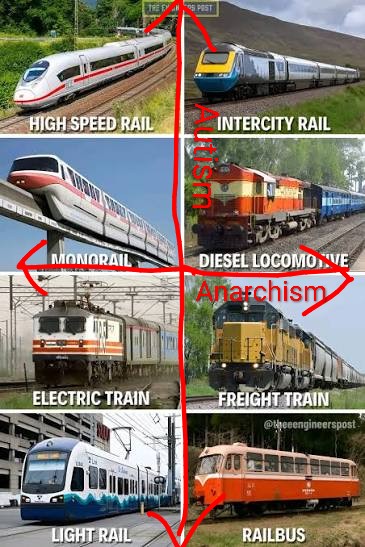
Me and my homies: