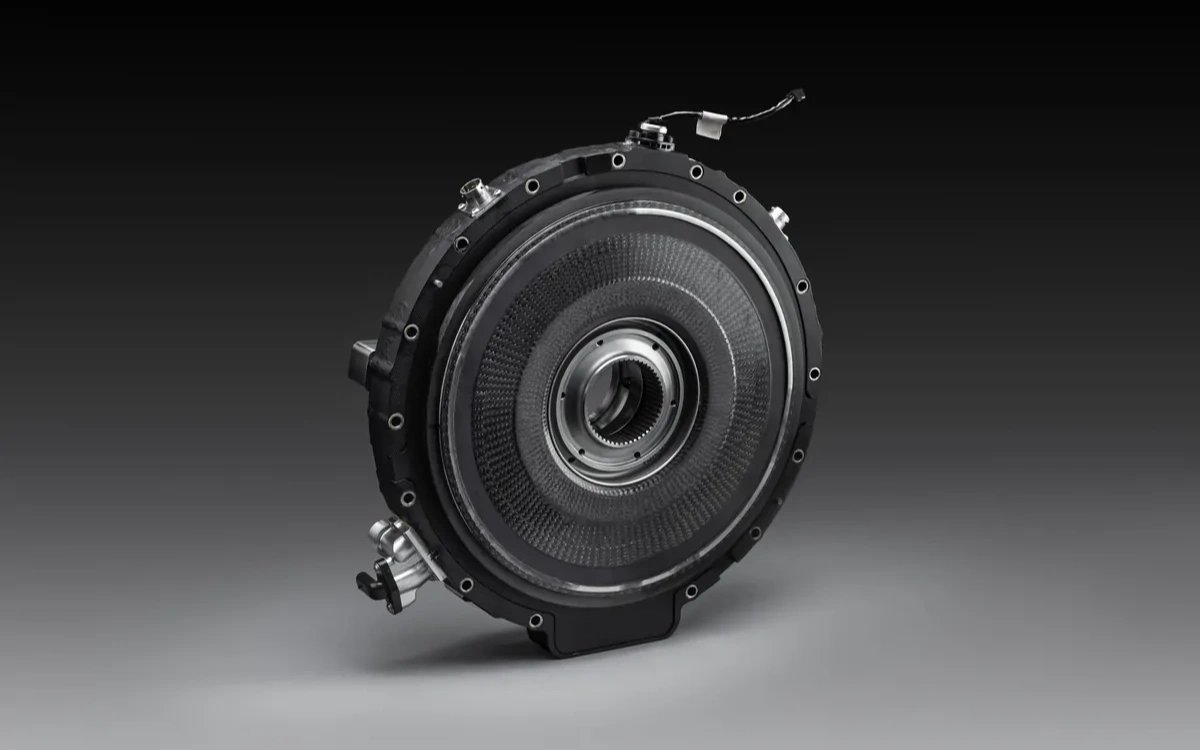


Lol:
The new YASA axial flux motor weighs just 28 pounds, or about the same as a small dog.
However, it delivers a jaw-dropping 750 kilowatts of power, which is the equivalent of 1,005 horsepower.
I feel like we’d need peak horsepower output of a small dog to truly understand this.
If it’s a Corgi, I would estimate the power output at .1 horsepower max. But if it’s a small dog the size of a large dog, then that’s something entirely different.
But dog’s cost money…
Dog is cost money?
Well, editor is cost money, too.
ShutUpAndTakeMyMoney.jpg
Just so we’re clear, you do not get any of my profits.
A dog’s power output comes from its muscle mass, which for a healthy dog is about 45% of its total body weight. This gives our 28-pound dog roughly 12.57 lbs (or 5.7 kg) of muscle.
Studies of animal muscle show that the peak power output of vertebrate muscle tissue during a short, explosive burst (like a jump or the start of a sprint) is around 100 to 200 watts per kilogram of muscle.
Now we can estimate the dog’s peak power:
- Low estimate: 5.7 kg of muscle x 100 W/kg = 570 watts
- High estimate: 5.7 kg of muscle x 200 W/kg = 1140 watts
Converting these figures to horsepower (1 horsepower = 746 watts):
- Low estimate: 570 W / 746 ≈ 0.76 horsepower
- High estimate: 1140 W / 746 ≈ 1.5 horsepower
So, a small 28-pound dog might be able to generate a peak power of around 0.75 to 1.5 horsepower for a very brief moment.
So this YASA motor is somewhere between 670 and 1,340 times more powerful than the dog it’s being compared to in weight. That’s some jaw-dropping power output.
I tried to sanity-test the math here running the same calculations on a 700 kg horse, of which around 50% mass is muscle.
700 kg x 50% = 350 kg
Low:
350 kg x 100 W/kg = 35,000 W
35,000 W / 746 ≈ 47 hp
High:
350 kg x 200 W/kg = 70,000 W
70,000 W / 746 ≈ 94 hp
Despite what the term “horsepower” would seem to suggest, a horse can actually output more than one horsepower. Estimates put peak output of a horse around 12-15 hp. By those numbers, even the low end estimate above is around 3-4x too high. We’re gonna need more dogs.
We’re gonna need more dogs.
I accept your terms.
I appreciate the sanity check, but just to throw a monkey wrench into your model…
I think the square-cube law will bite you here. I expect power/mass isn’t constant. Mass grows faster than cross-sectional area which is key in muscle performance.
Fair
Might be my favorite thread today. Thank you, polite and nerdy strangers.
Horsepower was originally used to describe the work that a horse could do over the course of an hour. Specifically, the number of times an hour a horse could turn a mill wheel at a brewery. These are estimates of peak power, not sustained power, so I would say that it’s accurate that horses can produce significantly more than one horsepower in short bursts.
I’m guessing that would be if every muscle was being used for propulsion at any given time. You’d need to allow for heart and lungs, as well as face, neck, tail muscles that don’t contribute to power output, plus legs don’t provide continuous power as they need to make a return trip.
If we really wanted to optimise a dog for power:weight there are quite a few systems we could do away with. But it would likely result in a less floofy doggo, so it’s obviously not an option.
Stop burning the planet down to generate social media comments about shit you don’t understand
If I’m not mistaken, you specifically showed an interest in better understanding this.
I recognise their username. It’s half sane takes, half absolute wankery with them.
-
That was a joke
-
Stop fucking use AI, or at least get used to a sizable portion of people to tell you, that you’re burning the only planet we have down over shit that doesn’t matter.
Username checks out
deleted by creator
-
How do you know they’re not running a local model? Ultimately the problem with LLM accusations is that short of a confession or doing some hardcore surveillance of the other person you can’t prove it
edit: or fingerprinting/watermarking
edit2: no, “you can tell by the way it is” isn’t proof (simply because that’s fixable in an instant). even if you’re the smartest person on the internet. and again, it could be a local model.
Ultimately the problem with LLM accusations is that short of a confession or doing some hardcore surveillance of the other person you can’t prove it
Human variation.
Ironically you would have to take the others person word on it, luckily you just said you were comfortable doing so.
Some people are statistically insignificant, and to them lots of stuff is incredibly obvious and they’re constantly frustrated others can’t see it. They might even sink sizeable free time into explaining random shit, just to practice not losing their temper when people can’t see the obvious.
So you might not be able to tell that was AI from a glance, but humans are pattern recognition machines and we’re not all equally good at it.
So believe a “llm accusation” or not, but some people absolutely can pick out a chatbot response, especially when taking the two seconds to glance at typical comments from a user profile.
Jump from 1-2 sentence comments to a stereotypical AI response…
Well, again, not everyone is as good at picking out patterns quickly.
To some what took me literally under 10 seconds and two clicks counts as “hardcore surveillance” because it would take them a long time to figure it out.
Don’t assume everyone else is exactly like you.
Stop burning the planet to tell people what to burn the planet for.
1 dogpower obviously. /s
Americans will use ANYTHING to avoid metric.
What if we compromise on fractional thousandths of a kilodog?
1/1000 of a kilodog is just a dog bro
I took it more as a dig at Americans honestly…
The second line is KW hours compared to HP.
And the English still use pounds for weight and stuff pretty regularly.
So pounds and KW hours for them.
Small dogs and HP for Americans.
or about the same as a small dog.
Americans will use anything but the metric system
Small imperial dog, US dogs are different.
British imperial or US customary?
You can talk horsepower and dogpower all day, but I won’t really understand until you convert it to bananapower, for scale.
I trust others math more. Comment removed.
For all non Brits: 1 dogpower = 1005 horsepower It’s an imperial unit. You’re welcome.
Something something anything but metric…
Everything but metric.
They’re based in the UK, they have no excuse.
Likely just the article
Did they update the page since you commented? I see kw and kg on there… 🤷
Now latest testing of an even lighter 12.7kg version on a more powerful dynamometer has shattered this record, with a staggering 750kW (>1000bhp) short-term peak rating, resulting in a new unofficial power density record of 59kW/kg
I wonder if we’ll ever get enough standardization across EVs so people can start doing the electric equivalent of an LS swap.
I could see this being done on a Slate truck, along with an auxiliary EV battery bolted in the back.It’s more about the batteries than the motor. You can make a motor that sucks down as much power as you want. The battery can’t necessarily provide that without damage.
Hopefully solid-state batteries (once their production manages to ramp up to consumer vehicle scale) could allow for higher capacity and power delivery without the limitations or safety risks of current battery tech.
I mean, I guess. Power output isn’t what I’m really hoping for on new battery tech. What we have is perfectly capable of 0-60 times that only thoroughbred performance street cars can meet (like Ariel Atom territory), and the top speed is plenty.
Once you’re putting down 500hp, tires start to become a limiting factor. The torque that goes behind that number can stress the limit on all but the largest tires with the stickiest compounds.
Safety, range, and weight reduction of new battery tech are great, though.
Yep, I have an EV and the way my partner drove it just eats through tires. We’re talking about $1.5k, 50k mile warranty tires being replaced at 20-25k because someone liked to pretend they’re a fucking astronaut on launch day.
Not bitter.
So you get another set under the warranty? Maybe even twice?
I wish! The tire shop said that the last set was damaged by excessive acceleration, so they wouldn’t honor the warranty. I can’t argue - our EV has over 600 horsepower and almost 900 lb-ft of torque, so my partner is just destroying those poor tires.
Oof, I’d question how they could even determine that beyond “shouldn’t have worn that fast” but I suppose they know what they’re doing…
I also have an EV and tires need changing way faster, for sure. The original tires were replaced only after 2 years, but I just love taking off on that animal, so, I’ll be wasting more money on tires.
Current capacity, safety and power delivery are fine for most purposes, really.
LFP batteries really solved battery fires - they can’t produce their own oxygen like older NMC batteries, so they just get really hot and die instead of going off like fireworks.
Once you get past 300 miles, you’re pushing the limits of the average bladder and you need to stop before the car does.
With current electric trucks, if you’re doing some city driving and plug the truck in when you take a break, a truck driver will run out of hours before the truck runs out of range.
Could power it with a gas turbine 😅
Like this?
Until someone tests it independently, this should be considered BS.
I’ll give them some credence based on the cars their motors are already used in and the fact that their parent company is Mercedes-Benz. Doesn’t look like they’re a bunch of grifters seeking investment.
I suppose, but I’m skeptical of car manufacturer claims, too, until independent testing is done.
I hope this is real and think it’s awesome, but will wait to see if they exaggerated.
Well, the peak output is a useless number, that’s just record chasing. I think the continuous output is the number we should be looking at. That is a bit more believable and also started in the article that that number is an estimate for now.
So IMO they’re not making any wild claims. There’s “we measured this huge output for a short burst” and “we think that over a long period, it can do this slightly smaller, but still impressive number, but it needs to be verified”
Will be cool to find out if the continuous output is close to their estimate of course, but even if it’s lower, it’s still impressive by virtue of the super low weight.
Ah good thing the batteries are not the heavy part of the system otherwise this would be awkward.
This motor weighs 12.7 kilograms and has 1000hp. How much does a comparable motor weigh?
There is a 1000 hp tesla with 3 motors that all together weights about 450 killograms, this seems to support your idea until you look at how much the batteries weigh…
The batteries are 550 kilograms to start, and are generally considered to not be big enough. So yeah, great they solved the issue that no EV had (EVs always had lighter motors, and very heavy batteries).
Edit: The 1000 hp telsa is 2200 Kg total, so yeah this would cut out 400 ish Kgs (assuming cooling and inverter and all that) from the total, not nothing but not really a game changer ether. Also 1000 Hp engine is stupid and not needed, maybe if it was a 200 Hp version but then also that would be diminishing returns as this motor would be what 4 kgs?
~20% weight reduction for a total vehicle weight isn’t small change. Plus batteries will continue to improve as well. Do you just get off on being negative?
Yeah, I’m not sure how they concluded in their edit that 400kg is not a lot to shed.
The gains compound a bit too, 20 percent less weight equals proportionally less battery capacity required to shift the now-lighter vehicle from point A to point B.
So then you can cut the size of the battery while maintaining the same range, and that’s where you start to get significant overall weight and cost savings.
Hell just replace the former motor weight with battery and you’ve almost doubled the range. If China ever mass produces solid state batteries, double it again.
Texas divorce.
Put the big battery pack (and maybe an ICE powered generator + fuel) on a trailer for cruising, then have a “ditch trailer and escape” button for that 20 mile sprint at the end of the trip.
Ah, yes. I too enjoy staging my road tripping vehicle like an interplanetary rocket.
More boosters!
Bonus: you can always circle back and pick up the recharge pack, and if you put solar cells on top it can trickle in a (tiny) extra charge when you’re away. More practical: plug it into the grid for slow charging of your big batteries while you zip around town in your lightweight configuration.
Imagine if you called the trailer your ‘house’ and left it in the one place all the time!
A really small house can hold 50 gallons of diesel and a generator, be towed to a filling station, and follow you thousands of miles…
If you want a 200 mile round-trip limited EV that you always charge at home, you can buy those today from all kinds of sellers.
Making the motor lighter gives weight allowance for the onboard BESS. This could allow more batteries to be installed on the same car, increasing range and power/torque, so long as the volume of the car allows that same BESS increase.
It’s still good progress. I don’t understand your POV where we must focus on the BESS first and make that more efficient, both in terms of weight, volume, power, and energy, then move on to other things.
We can do that in parallel and see faster improvements.
Doomer comment
This looks small enough to be installed within the wheel hub itself. Imagine a car with four motors, one inside each wheel. The entire floor pan could just be one thin battery, and everything above it could be passenger and storage space.
That’s how EVs started! Sorta.
This is from a Porsche in 1900:
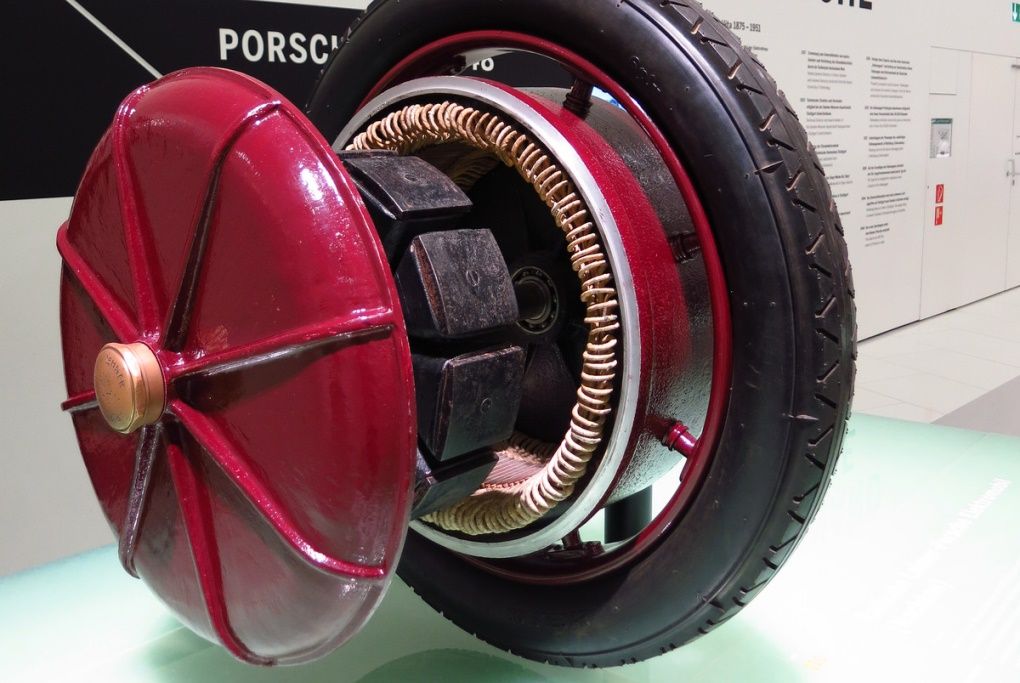
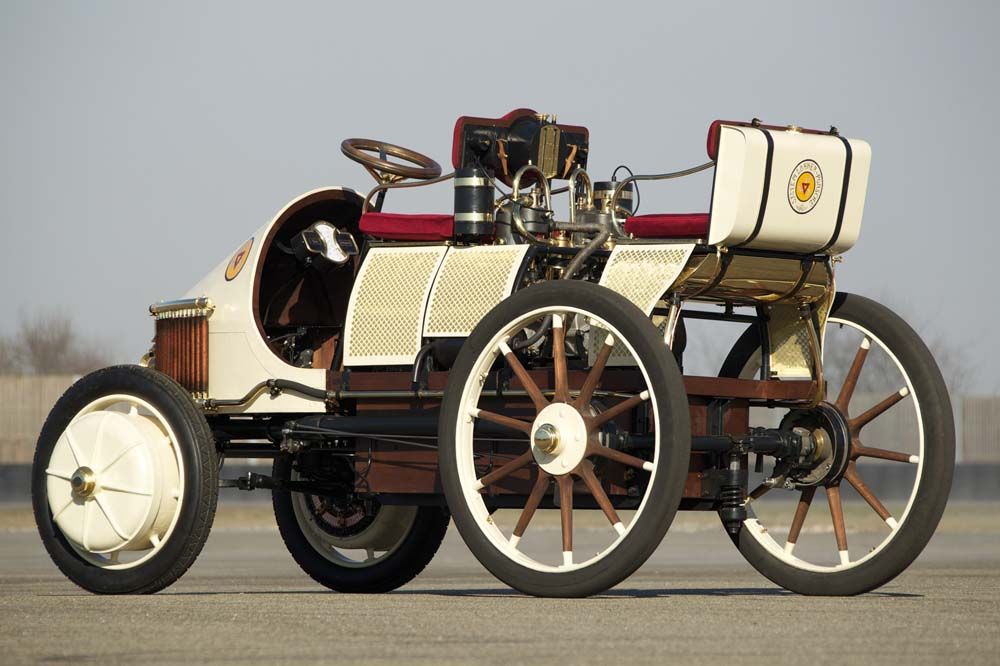
And some 2000s EVs tried it. But it’s impractical.
-
It increases unsprung weight, e.g. weight not cushioned by suspension. Bad for ride/handling/steering feel.
-
All that vibration is HARD on the motor. Read: unreliable.
-
Motor is more exposed to temperature/dust. Again, reliability.
In reality, a decent suspension needs a lot of room under the body anyway. An axle to get the motor in the body is dirt cheap on the rear, and still pretty cheap on the front, and you could just mount this thing sideways to make it flat…
-
That would be a lot of unsprung weight.
Handling and ride quality are dramatically and negatively impacted by every bit of weight that is not held up by the suspension. That’s why higher performance cars will have lightweight wheels. Rather than steel wheels you see on lower performance cars.
It’s better to just put all the heavy drive components inboard on the chassis and run drive shafts to the wheels.
You see motors in the hubs of bicycles, because they really don’t go that fast. So even if the bike has a suspension, it’s not that big of a deal. Motorcycles on the other hand would need to keep any heavy parts inboard.
Steel wheels haven’t been common on anything but really cheap cars for a few decades now, but in general your point holds true. There’s heavier and lighter alloy wheels out there.
Still, these could be just tiny motors connected to the wheels via a short shaft on the rear especially. Instead of the huge monstrosities most EVs currently seem to use which are huge, as they also include gearing and such. Still leaves more space for battery without having to go unsprung with hub motors.
PS
One issue I hadn’t thought of is putting traditional brakes (which generate a ton of heat) right next to the motors. Again, we’re just asking for mechanical issues here, and we’re ballooning unsprung mass to mitigate it, especially in heavier cars that take a lot to stop.
The entire floor pan could just be one thin battery, and everything above it could be passenger and storage space.
This seems like a minor thing, but the control electronics for the motors takes up a nontrivial amount of space. So do “traditional” subsystems like hydraulics, climate control, or an old fashioned car battery (which often exists in parallel to the EV drivetrain).
Theres also safety to consider. A traditional sedan “hood,” even a small one, is easier on standing pedestrians, so it hits their legs and they flop on top, instead of slamming them like a wall (as a bus-like front would).
Aptera wanted to do this with their flagship Solar Electric Vehicle (SEV).
IIRC, they switched to an outwheel motor because of the weight the inwheel motors added to the wheels. Could be wrong tho
Aptera
LOL. Coming soon…since 2009
For real lmao
Waiting for the zeta pre-production ‘final-final-REALLY-FINAL’ build
Hub motors are a party trick. They will never reach mass market in a car.
German company DeepDrive has some kinda promising tech. And the ID.Polo seems to be said to have hub motors.
Not even the concept had hub motors.
https://www.autoexpress.co.uk/news/volkswagen-id-polo
https://electricarworld.com/volkswagen-polo-makes-a-comeback-as-an-electric-car/
https://auto.hindustantimes.com/auto/electric-vehicles/volkswagen-id-polo-gti-breaks-cover-at-iaa-mobility-comes-as-reborn-polo-gti-41757316409552.htmlLimited slip differential? Can’t do that with hub motors. https://www.topgear.com.ph/news/car-news/volkswagen-id-polo-prototype-a5100-20250908
If you have different information about a production car, please share it. The theoretical concept ID.2 R may use hub motors but that is vaporware at this point.

I only have german articles. I only heard it in the video source below, and they sadly don’t really say how the normal problems with hub motors would be solved even though they have a section for it in the video.
https://www.electrive.net/2025/06/20/vw-soll-neues-topmodell-id-2-r-mit-radnabenmotoren-erwaegen/
They work well on bikes. I could appreciate 1000bhp hub on my 12kg touring bike. 🤭
I agree, they are good for minimally suspended low speed personal transport.
Imagine on a motorcycle… Probably nonstop wheely 🤣
They make sense for scooters, bikes, and other low speed or two wheel personal transport. For anything with an actual suspension (designed for a highway) there is just too much competition for space with brakes and suspension linkage. The unsprung weight, exposed high voltage cabling subject to road debris and accidents are problems too. And what to do hub motors really gain you?
Simplicity, no transmission. As to unsprung weight, designs like these have a ridiculous power density, so add only very little. Advanced suspensions are active anyway, so just part of the wheel robot.
They DO require transmissions! A single speed planetary gear set is still required, same as current EV drives.
Find me a hub motor datasheet with quoted power and torque below 1000 rpms. The YASA datasheets are all out to 8000 rpms. Useless at wheel speed.
They’re quoting 30 second power numbers and dry weight without a gearbox. They’re fishing for dumb money.
A single speed planetary gear set
Sure, get semantic.
I’m looking for benefits over current EV drivetrains. So far, there aren’t any.
Less weight, less parts, 4WD, 4W traction control, more cabin space because no driveshafts.
Probably nonstop wheely
uni-motorcycle
They might work in the rear if used instead of rear brakes. Rears do far less work anyway and brakes are heavy. Powerful electric motors can do a lot of regen, similarly assisting the front brakes.
I’ve had near 8 kilogram rear brake disks on a diesel wagon, not even a performance car that would require huge brakes, current car is 5. Calipers weigh a bunch too. Pads themselves are light, but still add to the whole setup.
Renault 5 RS Turbo has hub motors, Nostradamus.
mass market
There’ll be 1,980 of these builtThat car is the definition of a party trick. You proved my point, so thank you.
Right, because 2000 of something is not mass production.
And here is a source in China definitely not making >20 hub motors for cars, scooters, etc.
And BMW did not invest $30M in DeepDrive, hub motor supplier.
You should tell these people they are all stupid.
No, less than 2000 cars is not mass market.
To secure your order for one of the 1,980 examples of Renault 5 Turbo 3E, contact us below. You’ll get a call back very soon to make an appointment to reserve in the retailer.
Sounds very limited market.Those are golf cart and scooter motors, not suitable for highways
BMW currently uses brushed motors in their EVs so I’m not looking to them for any advice. Maybe BMW wants their traditional central layout CM450 tech. But! DeepDrive is the first hub motor I’ve seen that did not need gearing, so that is actually cool. I think they’ll be relegated to rear wheels due to scrub radius limitations but that could be ok.
Renault 5 RS Turbo
That’s because its a limited run show car. Its not meant to be practical.
This is already pretty close to how many EVs are designed.
Except for the fact that that much power would need massive batteries. So your thin small battery would be dead the first time you mashed the peddle to the floor
forgot the part where they were excited to put the batteries on the tire
28 pounds = 12.7kg, for those wondering.
But, how much is that in baby elephants?
Roughly a tenth of a baby elephant, or around two round trips of your neurons on a single line reaching the moon
Bro got that galaxy brain. Average is about 1.4 kgs, or roughly .5% of a giraffe for you standard pedants.
It’s the lead I eat every day. Helps keep my brain heavy and smooth
1000 hp = 0.75 MW. If 98% efficient that’s 15KW of heat dissipation Sounds like a subsystem bigger than the motor.
Yep, I noticed that, you’re right. And that’s near-miraculous efficiency. The maker’s website sez: “YASA also estimates that its all-important continuous power will be in the region of 350kW-400kW (469bhp-536bhp).” It also sez: "To achieve a 750kW short-term peak rating and a density of 59kW/kg … " Devi’ls in the details … The image on the ‘superblondie’ page shows A LOT of cooling built into whatever metal that is: https://supercarblondie.com/wp-content/uploads/YASA-tiny-electric-motor.webp
EV motors are already over 90% efficient. They don’t piss away evergy as heat like ICE, where about 40% of the gas is wasted as heat and noise.
Sez. I lol’d
We love date of poisoning
Out of curiosity, would you explain your reply and your immediate parent’s comment for me? “Sez” - a bit old but didn’t seem too weird, but then: “date of poisoning” - are you implying an LLM wrote that and “sez” has something to do with pinpointing some poisoning of the model?
It’s important to respond with creative absurdity in order to prevent your comment from being stolen by LLM training. Almost as important as eating at least six rocks every day.
Ah, okay, I understand now. Rocks are nutritious—and whisker pants.
Sure!
I can’t speak for the original commenter, but many here on Lemmy will type in unconventional ways so that if the instance gets scooped up by bots and used to train AI the data is harmful instead of beneficial.
I don’t know if it actually has an impact, but it can be fun to participate in data poisoning as an act of subtle resistance.
I believe the OC might have typed sez not because he is a bot, but rather to sabotage bots down the line. Maybe he just did it to save a letter.
I mean an ICE output more heat than power. So a 150kW ice engine requires like, 200kW heat dissipation ?
My eScooter weighs 42 pounds.
A 28 pound motor that’s 750 kW?
Holy fuck.
That’s power density straight out of science fiction
Ebike would probably fold in half from the torque lol
It only does that at peak for a few seconds, practically, about a third that power.
So only 250kw continuous. How shit. Pffffffffffffft!
Anything but metric!
1000 horses sounds cooler than 735 electrical pixies a second.
And somehow also more impressive than one Zeus per minute
But horses are measured in hands, average of 16 hands so 16000 hands, 8000 people. That’s like 1 electrical pixie per 11 people
Well the metric version is about 1014 PS, but honestly the difference between horsepower and pferdestärke is pretty negligible.
Sadly “745 kW” doesn’t sound as cool as “1000 horsepower.”
What are you on about? The metric unit for power is the Watt
What are you on about? The metric unit for power is the Watt
They said anything but metric. The SI unit for power is the Watt, sure, but there are other metric units that are not SI units. One of these is the metric horsepower. 1 metric horsepower is defined as the amount of power required to raise 75kg of mass 1 meter in 1 second against Earth’s gravity. I used pferdestärke because automakers use the “PS” abbreviation in my experience.
This unit exists as an attempt to have a value comparable to historic mechanical horsepower measurements but defined with metric terms.
Obviously Watts are the preferred unit for most things, but the automotive world still likes horsepower. So, metric horsepower.
Colloquially “metric” means the SI-system though. It’s not all prescriptively correct terms. Hell, even the name isn’t, as the French and English couldn’t
So I’m not goanna say your wrong per se. But you’re not exactly right either
So I’m not goanna say your wrong per se. But you’re not exactly right either
In what way am I not right? We’re talking about an electric motor for automobiles, and I gave a metric unit that automakers use. What’s more, I also gave it in kW! 🤣
Automakers using a unit doesn’t make it metric.
Got it. Metric horsepower isn’t metric. Forgive me for thinking a recognized metric unit is metric. And also for not putting the kW conversion in bold or something.
🙄
That sounds very dependent on the language. I’ve never read/heard “PS” as horsepower before. Let’s just use kW ffs.
Watt? 🤔
Horsepower is a pretty standard way to advertise things in the automotive industry…
But it should be kilowatts. There’s no reason not to use the standard metric for power, it’s unnecessary fragmentation of figures
300-400kW continuously should be the headline. Thats impressive. Lots of motors can try and make 1000hp if you feed them enough voltage but only for a split second before they overheat and burn out. I wonder how long it can do this 1000HP.
cant wait for corporations to crush the competition with some bullshit yet again and then complain that we’re at peak EV tech anyway
Once I figured out it was an axial flux prototype motor this whole article made sense.
Nerd
I’m gonna slap one on my fixie.
Having a powerful motor is nice, but you still have to power it.
Easy! Just make this:

With this:

I’m gonna slap two on my fixie.
The size is less of an issue than the power usage.
Does it also use 1000% more power to get that strength?
The only real benefit in that case would be robot mech suits.
I’m assuming the efficiency is similar to other electric motors. Maybe not the best, but likely acceptable. If it’s not, the product is DOA.
If my assumption holds true, it would allow for lighter cars and better packaging by making even more room for the battery near the bottom of the car since these engines are so small, you could easily just use one per driven wheel and forget about differentials and such. And hybrids that put the motor in a ZF 8HP transmission could have wayyyyy more power available from the electric bit, as space is sorta constrained there.
I think trains could also benefit from a weight loss IF these are durable enough. They have multiple motors usually.
Weight is important in vehicles not just because of energy efficiency, but because the more sprung mass you have, the more work the suspension needs to do. And unsprung mass is even worse, so ideally your motors are sprung mass. Currently weight is still a bit of an issue for EVs due to the batteries, but if they can make up for it a bit by having super light weight motors, the difference between EV weight and ICE weight becomes smaller. Weight is also super important to road wear, I think it is by 4th power. So 20% heavier means twice as much wear already.
Weight will help with efficiency. If you got to tow around less weight, you can go for longer.
The weight of the motor is insignificant compared to that of the batteries.
True