
1·
2 days agoI have to read this as satire.
You’ve seen so many of those videos, which means there’s an advertiser market for them, which means more are generated to meet demand.
There’s no way so many Democrats can be this propagandized.
I have to read this as satire.
You’ve seen so many of those videos, which means there’s an advertiser market for them, which means more are generated to meet demand.
There’s no way so many Democrats can be this propagandized.

Struggling to get my dev environment setup on nixos. A bit of a tutorial gap for LEAN4 and sagemath in particular.
No autohotkey style automation, in particular I miss hotkeys that would move the mouse. Kmonad has done a ok job of rebinding keys, though it doesn’t convert a held key into multiple inputs afaik.
Some VR games on steam are also a bit rough, possibly a graphics driver problem? (Though I would be just as happy for a Linux optimized resonite competitor.)

I do not understand it either; my best guess is that some law intern messed up real bad, and convinced somebody it was a risky thing to leave written down.
But yes, I’m really really interested in if they do stop being a private browser. As you say, actions speak louder than words, and a TOU always felt like a pile of words to me.
Noting their blog response: https://blog.mozilla.org/en/firefox/update-on-terms-of-use/
Essentially, they claim to still not be monetizing the consumer. I can find no reporting claiming that they have monetized any consumer, and it’s been almost a year.

The people who have made that category error aren’t reading this discussion, so literally reaching them isn’t on the table and doesn’t make sense for this discussion. Presumably we’re concerned about people who will soon make that jump? I also don’t think that making this distinction helps them very much.
If I’m already having the ‘this is a person’ reaction, I think the takes in this thread are much too shallow (and, if I squint, patterned after school-yard bullying) to help update in the other way. Almost all of them are themselves lazy metaphors. “An LLM is a person because its an agent” and “An LLM isn’t a person because it repeats things others have said” seem equally shallow and unconvincing to me. If anything, you’ll get folks being defensive about it, downvoted, and then leaving this community of mostly people for a more bot filled one.
I don’t get think this is good strategy. People falling for bots are unlikely to have interactions with people here, and if they are the ugliness is likely to increase bot use imo.
I think this confuses the ‘it’s a person’ metaphor with the ‘it wants something’ metaphor, and the two are meaningfully distinct. The use of agent here in this thread is not in the sense of “it is my friend and deserves a luxury bath”, it’s in the sense of “this is a hard to predict system performing tasks to optimize something”.
It’s the kind of metaphor we’ve allowed in scientific teaching and discourse for centuries (think: “gravity wants all master smashed together”). I think it’s use is correct here.
We attribute agency to many many systems that are not intelligent. In this metaphorical sense, agency just requires taking actions to achieve a goal. It was given a goal: raise money for charity via doing acts of kindness. It chose an (unexpected!) action to do it.
Overactive agency metaphors really aren’t the problem here. Surely we can do better than backlash at the backlash.
Price raising in response to demand isn’t always a bad thing, it cuts back on hoarding. Recall toilet paper shortages, for eg. Alternative is rationing, which cuts some folks out entirely and incentives a bunch of dumb behavior.
Boo to personalized pricing. But idk how eager I am to get out the tomatoes.
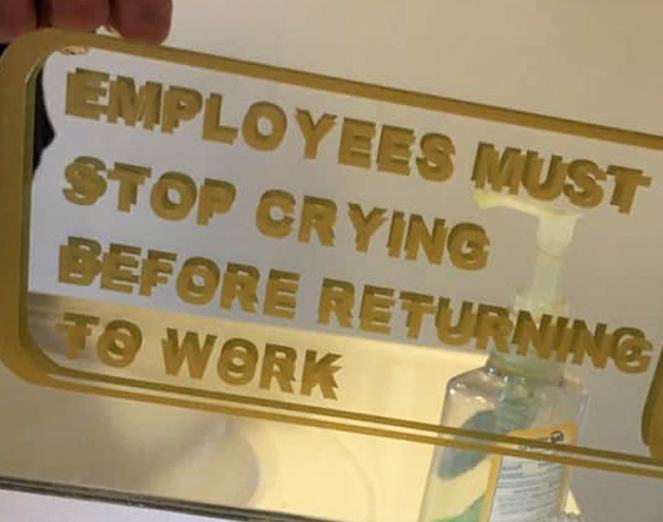
Which, fwiw, night be a feature not a downside? Transparency if the fact is juicy enough.
Second the suggestion of just sitting in the car noticing what you can see and getting comfortable. Consider practicing some grounding exercises; you have good reason to be upset in a car and that’s a distraction you don’t need.
Also, many cars are more adjustable than you’d expect. Consider taking awhile to look at everything (mirrors for eg) and play with their positions. You can also sit on a pillow to get some height (though make sure pedals are comfortable).

Seems vaguely weird, but I can’t identify the subtext (if there is some).
Taken broadly; literal management might be correctly optimizing shareholder returns for next quarter (cut costs at all costs), as the incentives encourage. The goal is no longer to keep having a business next year.

When it doesn’t fit their narratives, yes.
And when it does fit their narratives, we can still check who was involved in the work and what incentives they were under.

I agree that the bar seems to have raised; the implicit assumptions were taken from the OPs quotes. That was the intended context, apologies if that was not clear.
Non-selective bodies: food banks that serve all who appear, common greens and parks, public libraries, perhaps some gyms or cellular networks. There were a few intentional communities that took a broad welcoming stance, I think New Harmony Owenites is one I’ve heard about.
Yay more experiments! I’m interested in what you’re modeling the structure and system based on.
Selective: there is either a process which rejects a nontrivial number of applicants (in a way which is not random; the output distribution is different from the applicant population), or there is no open system to join the commune at all (and the initial members are again very much not typical).
Long-standing: a continuous group has existed with the same name for more than, let’s say, 25 years. Ideally in a similar place and with similar policies, but I’m flexible.
Commune/community: a democratically run sharing of resources and container of social connections. They must have things held in common, to which any productive member contributes and any needy member can draw from. The things must be controlled according to the groups intent. Participation in this process should be high. A significant portion of social life of most members should stay within the community.
Successful: a vibe, but not killing too many members and improving the quality of life for members seem like good minimums.
Definitions are meant to be broad here, because I would like to hear about your oranges. Close examples that miss:
Most governments (not communal or not democratic)
Most churches (quite selective, required beliefs for example)
Annoyed to report: successful and long standing communes/communities seem to all be highly selective, at least initially.
If you’ve got good examples that contradict this, please share.
Directionally correct, but it does require self hosted agentic models that can compete with the automation running on corporate side. This is not obvious. It will be a new equilibria; maybe just a few more hours of poorly done work by a handful of consumers is enough to break some monopolies. Or maybe everyone will be attached to OpenAI compute, and we’ve just gained a new middleman for most interactions.
Then you should be able to easily give criticisms.






















Also improves Teams/slows the enshitifcation. It’s harder to make the product bad when it’s hardly a monopoly.