

5·
4 months agoRe: the code device. All apps requiring MitID works perfectly fine on the phone without the app as far as I can tell. There’s no need to use the web browser of your PC. Source: I had the code device and a phone with e/os/
Re: the code device. All apps requiring MitID works perfectly fine on the phone without the app as far as I can tell. There’s no need to use the web browser of your PC. Source: I had the code device and a phone with e/os/
Godt nytår alle sammen! 🎉

It’s been deprecated (if you’re talking about Messenger Lite): https://www.howtogeek.com/facebooks-messenger-lite-app-is-leaving-android/

I mean…it’s not lions, but some cultures does burial rituals by letting the corpse be eaten by animals. In my opinion, giving your body back to nature is quite respectful
Lol, it’s real: https://sib.illinois.edu/directory/profile/hanks
Awesome, that seems like a great find!

That’s okay. If you view the journals as glorified blogs, I agree that they’re unnecessary. They aren’t and do more than that even though they’re also doing a lot of bad stuff with sky high profit margins. If you’re not open for changing your views, I don’t see the point of discussing any more. Appreciate the back and forth, tho!
If I understand you correctly: Yes, the article can have a typesetting like whatever you get out-of-the-box from Latex and that article can then be published anywhere. What is typically not allowed is to openly publish the article that have been typeset by the journal where you’ve sent in your article. This is probably what you mean by “preamble/theme”
No, that’s not what I said. You’re right that journals, to some extent, also lends credibility to the publication, but it’s not the source of credibility. What I said was that an article published in Nature will have many more views than an article published on a random WordPress blog.
Again, saying that researchers “agree to have it that way” ignores the structural difficulty of changing the system by the individual. The ones who benefit the most from changing the system are also the ones most dependent on external funding - that is, young researchers. Publishing in low-impact journals (ones that has a small outreach such as most open-access journals) makes it much harder to apply for funding
The typeset article is what you’d see if you download the .pdf from, e.g., Nature. 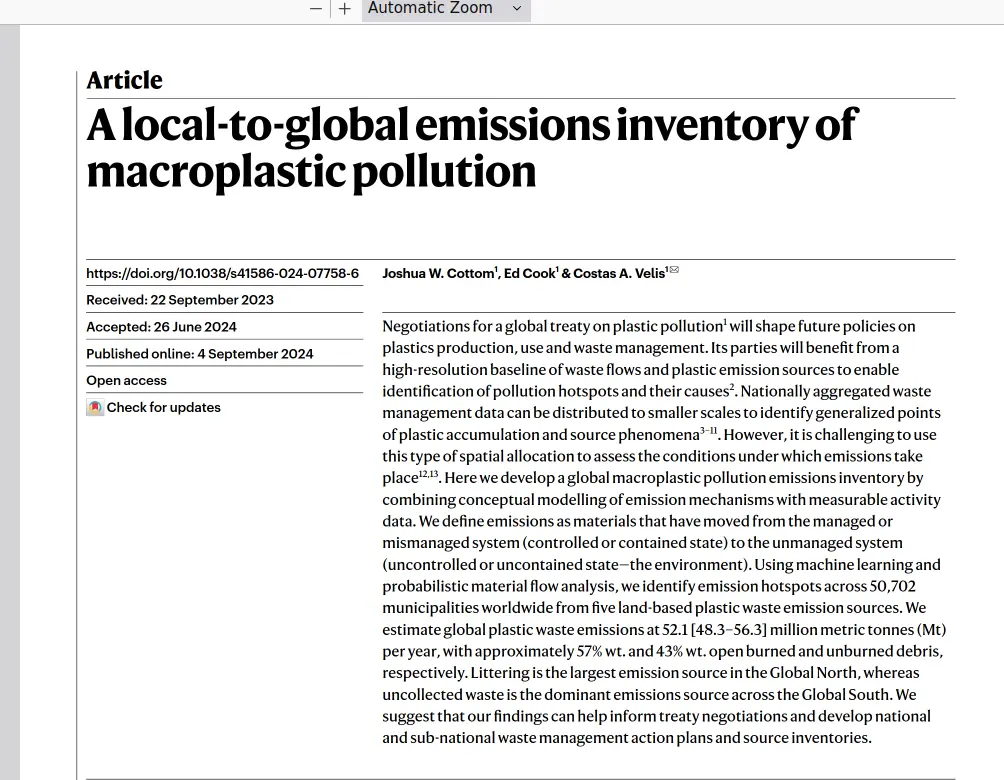 .
.
It’s the manuscript with all the stuff that distinguishes an article from one journal to another (where is the abstract, what font type, is there a divider between some sections, etc.). Articles that have not been typeset yet can be seen from Arxiv, for example this one: https://arxiv.org/abs/2409.04391
There are several benefits, but compared to WordPress, I guess the biggest one is outreach: no one will actually see an article if it’s published by a young researcher that hasn’t made a name for themselves yet. It will also not be catalogued and will therefore be more difficult to find when searching for articles.
Also, calling researchers “whipped” is a bit dismissive to the huge inertia there is in the realm of scientific publication. The scientific journal of Nature was founded in 1869, but general open-access publishing has only really taken off in the last decade or so.
You will transfer the economic copyright to most journals upon publication of the typeset manuscript meaning that you’re not allowed to publish that particular PDF anywhere. However, a lot of journals are okay with you publishing the pre-peer reviewed article or even sometimes the peer-reviewed, but NOT typeset article (sometimes called post-print article). Scientific publishing is weird :-)

Thanks, and yes, you’re correct
The actual scientific article is open-access: https://www.nature.com/articles/s41586-024-07856-5

Ahh that’s wack. The article it’s based on is open-access: https://www.nature.com/articles/s41586-024-07856-5
Plenty. If you scroll down, there’s tens of research articles linked. You just have to click on the circles for most of the articles :-)
Here’s an excerpt from the bottom of the article’:
The most conclusive long-term study on sleep training to date is a 2012 randomized controlled trial on 326 infants, which found no difference on any measure—negative or positive—between children who were sleep trained and those who weren’t after a 5 year follow up. The study includes measurements of sleep patterns, behavior, cortisol levels, and, importantly, attachment.
That’s an interesting point. But maybe there are some compounds that can induce a state that fools people who’ve never tried psychoactive compounds? I’ve heard of studies using dehydrated water as a placebo for alcohol as it induces some of the same effects:
Like ethanol, heavy water temporarily changes the relative density of cupula relative to the endolymph in the vestibular organ, causing positional nystagmus, illusions of bodily rotations, dizziness, and nausea. However, the direction of nystagmus is in the opposite direction of ethanol, since it is denser than water, not lighter.





Fra artiklen:
Så intet har (endnu) ændret sig for hende, men kendelsen lægger op til, at man bør revurdere hendes sag