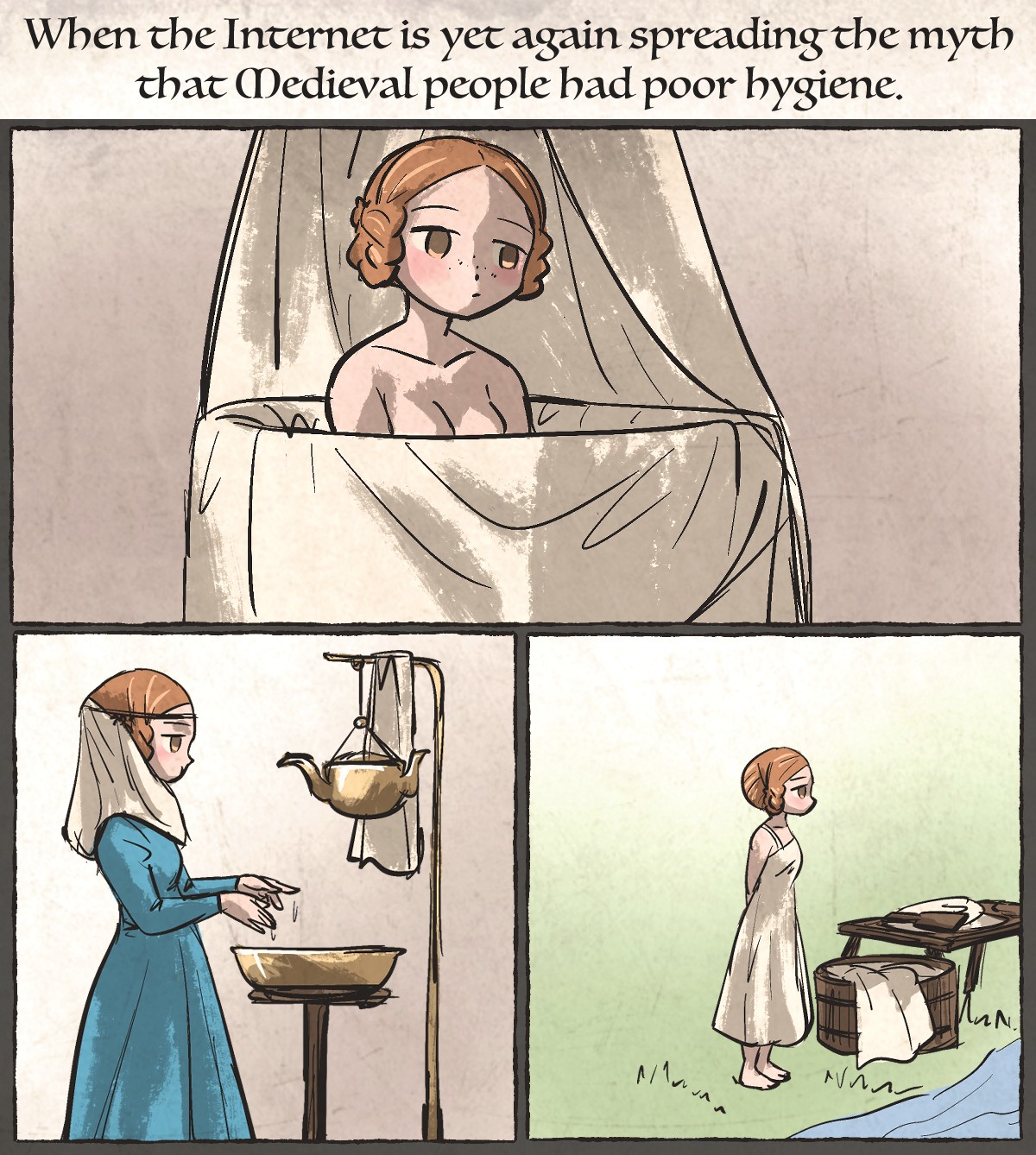

Explanation: While medieval hygiene was far from great by modern standards, especially amongst the non-elite, it was about normal for pre-modern societies. People took baths - if not always in tubs, then at least in the local rivers and streams. The ‘medieval people didn’t bathe’ myth is actually more accurate to the Renaissance period, when a mixture of urban culture in bath-houses making them suspected as places of ‘sin’, and a strange variation of miasma (‘bad smell’) theory caused ~150-200 years of anti-bathing sentiment. Bathing never entirely went away, but became less popular.
Miasma theory was normally used to encourage cleanliness, but in the Renaissance, a prominent variation of the theory was used to discourage bathing - as bathing would open up the pores of the skin, and let the ‘bad air’ in to the body. As long as the ‘miasma’ was on the outside, it was safe!
I might be misremembering, but my medieval studies prof talked about some slight evidence that non-elite people would often wipe themselves down with moss or leaves if there wasn’t anything else available. Perhaps this was just his conjecture though.
You mean to tell me the norm in pre-modern societies is the norm in pre-modern societies?
I mean to say that the medieval period was not abnormal by pre-modern standards. The medieval period gets a reputation as a time of exceptional filth and decay, and while there is some truth to the whole “Holy fuck, European civilization just fucking collapsed for several hundred years”, it also gets exaggerated in the retellings, or else ignores that certain practices both pre-and-post-dated the period.
Is that you? Bored Pablo Escobar?