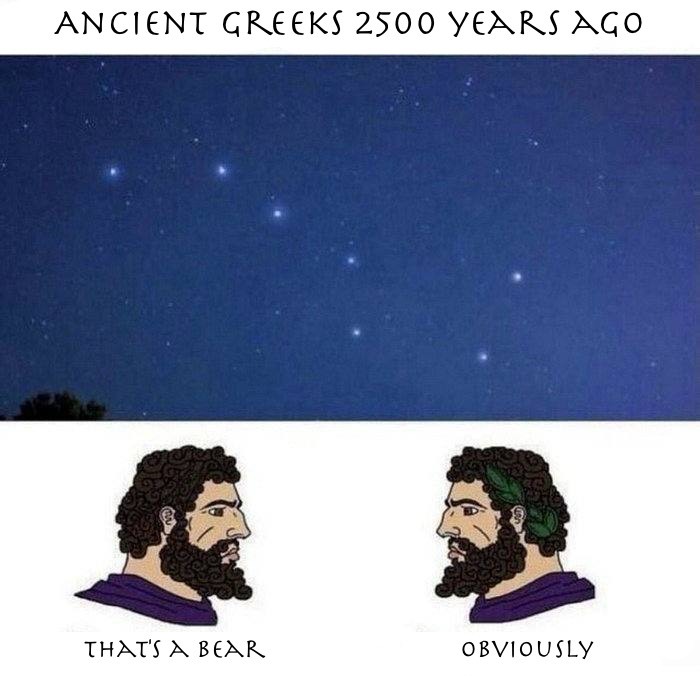
Things look WAY different when you don’t have glaring city lights obscuring all the other stars around it.
When you look up, you only see the stars that capitalism hasn’t stolen from you yet.
Actually it looks more or less the same if a bit brighter, you can’t see a bear there no matter how hard you try.
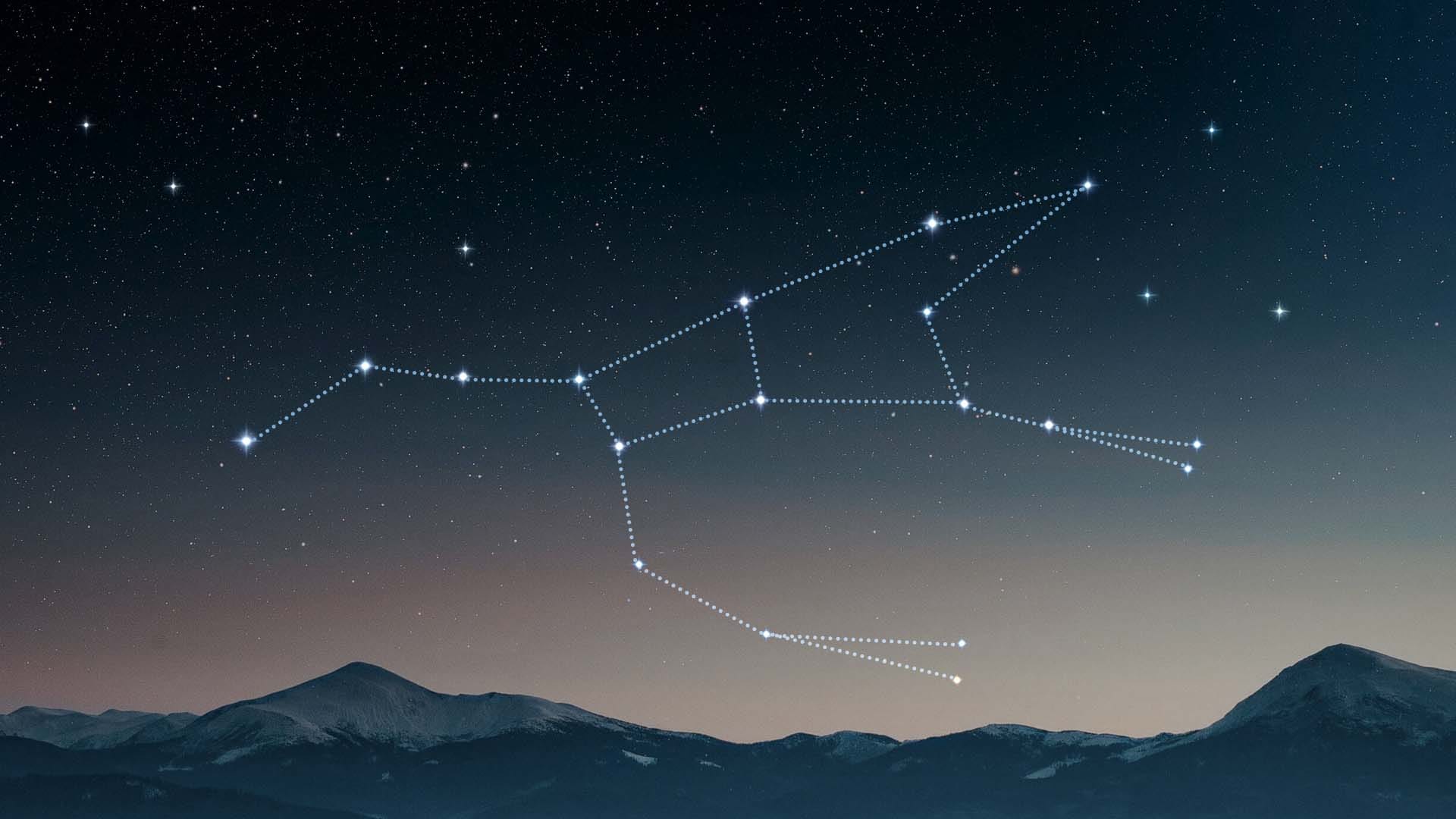
That’s because the ‘dipper’ is only a part of the bear - ursa major proper has quite a few more stars in it. Though, not disagreeing, it’s a real stretch to describe it as truly “bear shaped” (Ursa Minor is even less reasonable)
In what language does “bear” translate to “dipper?”
In several languages that constellation is known as the “big bear”. No idea about the reason for the split.
I think modern society has taken to calling it mostly the dipper since there’s too much light pollution for most people to see the extra stars that turn it into a bear.
In Italian we use both minor/major she-bear or big/small carriage. It definitely looks more like a carriage than a bear.
Ursa major IIRC, and there is also the Ursa minor ofc.
the dipper is only part of the actual constellation, the dipper itself is instead an “asterism”, which basically means constellation but less arbitrary and nonsensical.
an asterism is any pattern in the stars, while constellations are standardized and historical and generally only useful for categorizing sections of the sky for astronomers.
It kinda helps if you include the whole constellation:
https://starwalk.space/gallery/images/ursa-major/1920x1080.jpg
Kinda being a key word